
How El Paso County Residents Come Into Focus
There is no verified countywide roster of every person who lives in El Paso County. The sound way to use a residents directory is to name the relationship shown by each source. The Assessor connects an owner or mailing address to a parcel. The Recorder connects a person or entity to a recorded instrument. Elections can confirm an individual voter record when the state form accepts the supplied details. A city directory, obituary, cemetery entry, or archive item shows a person or household in a dated community setting.
Start with the least costly route that can answer the narrow question. Keep the county, municipality, address form, and retrieval date beside each result. A blank search means no result in that portal and query. It does not mean that a person has no record. That distinction keeps the El Paso County residents directory useful for family history, reconnecting, house research, and civic study without turning one clue into a claim about a whole life.
- Normalize the name or address, including a municipality, old street form, parcel number, or ZIP when known.
- Check the El Paso County Assessor by schedule or parcel number, address, or owner name, and keep owner, mailing, and situs fields separate.
- Search the Recorder as both grantor and grantee, then save the instrument number, recording date, document type, and legal description.
- Use the Colorado voter lookup only for its individual confirmation purpose, or request a lawful county voter product for a defined scope.
- For a past household, pair Pikes Peak Library District directories, maps, newspapers, or cemetery records with a deed, plat, or probate trail.
That short chain gives a better starting point than a broad name search. It also shows when the next step belongs with a counter, a request form, or a reading room rather than another online query.
El Paso County Resident Records Offices
Most current El Paso County directory work begins with three county offices. The Clerk and Recorder holds the real-estate and marriage indexes. The Assessor maintains the parcel and tax-card view. Elections handles voter products and the state lookup route. Their records overlap in place and name, but they do not prove the same thing. An owner is not automatically an occupant, and a voter result is not a deed.
The public index is often the right first stop, followed by a request for a copy or certification when the index line matters. A focused question helps staff locate a record because the Recorder says it is not required to perform a search on a requester’s behalf. Keep the relevant parcel, date, instrument, or party role ready before calling.
El Paso County Clerk and Recorder
1675 W Garden of the Gods Rd
Colorado Springs, CO 80907
(719) 520-6200
El Paso County Assessor
1675 W Garden of the Gods Rd, Suite 2300
Colorado Springs, CO 80907
(719) 520-6600
El Paso County Elections
1675 W Garden of the Gods Rd, Suite 2202
Colorado Springs, CO 80907
(719) 575-VOTE
The El Paso County recording index is free to inspect, while office copies and certified copies carry the current fee rules. The Assessor warns that its data changes daily and that legal-use copies should come from the office. Elections products have their own request path and confidentiality rules.
El Paso County Assessor Fields That Prevent a False Match
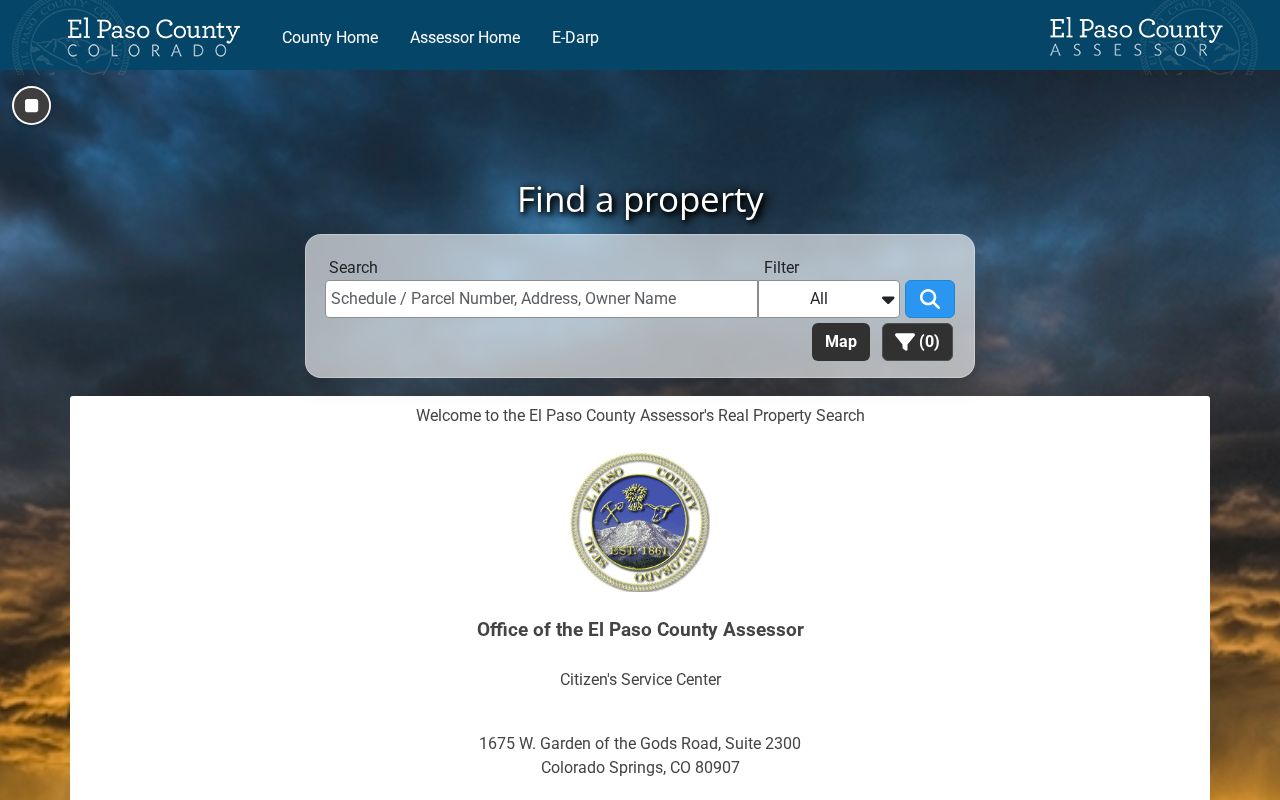
The El Paso County Assessor Real Property Search is a strong parcel tool when its fields are read with care. The opening selector accepts Schedule / Parcel Number, Address, or Owner Name. Results can be sorted by schedule number, address, or owner name, then viewed as a list, grid, or map. An Excel export was capped at 500 records in the inspected configuration, so a broad result is not the same as a complete county extract.
| Portal field | What it helps locate | Limit to record |
|---|---|---|
| Schedule / Parcel Number | A stable parcel route when an address changed | Parcel identity, not occupant identity |
| Address | A situs or location string and matching cards | Mailing and situs may differ |
| Owner Name | A tax-roll owner or named entity | Owner may live elsewhere |
| Assessor Neighborhoods | Groups such as Old Colorado City, Briargate, Falcon, or Tri-Lakes | Map grouping, not a legal boundary |
| Property card | Owner, mailing address, location, zoning, plat, legal description, and values | Daily data; official copies come from the office |
For El Paso County research, record the exact label shown for Owner, Mailing Address, and Location. The last is the situs address. A trust, business, trustee, or government entity can appear in the owner field. Follow the card’s deed link into the Recorder and compare the legal description rather than treating a mailing line as proof of a household.
The official assessor search shows how parcel and owner modes sit beside one another in the El Paso County property workflow.
El Paso County Deeds Turn Names Into Document Trails
The Recorder’s real-estate index is the clearest El Paso County route from a name to a recorded transaction. Its public form offers Combined Name Search with a surname-first Party Name, a Role selector, Both, Grantor, or Grantee options, Separate Name Search, date ranges, instrument numbers, Book, and Page. Document types range from Warranty Deed and Quit Claim Deed to Plat, Easement / Right of Way, Beneficiary Deeds, Deed of Trust, Lien, Trust, and Power of Attorney.
Search a person in both party positions. Then narrow the date or document type and save the instrument number, recording date, role, and legal description. The Permanent Index line observed during research began on January 1, 1980, while the Recording Department describes remote images as 1996 to present. Those are different coverage statements. A pre-1996 image or copy may need the main office, even when the index line is visible online.
- Roll
- A list maintained for a purpose, such as the Assessor’s property or tax records.
- Index
- A finding aid for a recorded document. An index entry is not the certified instrument itself.
- Parcel
- A mapped unit tied to an assessment schedule, legal description, and property record.
- Criss-cross directory
- A historical address-to-name or name-to-address aid, not a current county resident roll.
The El Paso County real-estate index is the source behind this deed-search view.
Current El Paso County Resident Directories By Purpose
Current directory sources answer different questions. A compact coverage map prevents the most common error, which is calling every public row a resident record. Use the source that matches the relationship, and label the result with the keeper and date.
| Source | Relationship shown | Keeper | Access route |
|---|---|---|---|
| Assessor property card | Owner, mailing, situs, parcel | El Paso County Assessor | Public portal; office copy for legal use |
| Recorder real-estate index | Party to a recorded instrument | Clerk and Recorder | Free index; copy or remote image rules apply |
| State voter lookup | Individual registration confirmation | Colorado Secretary of State | First name, last name, ZIP, birthday |
| County voter products | Defined voter-list, label, or map fields | El Paso Elections | Order in person or by phone under county rules |
| Historical directory | Publication-time household or business listing | Pikes Peak Library District | Digital items, microfilm, or reading room |
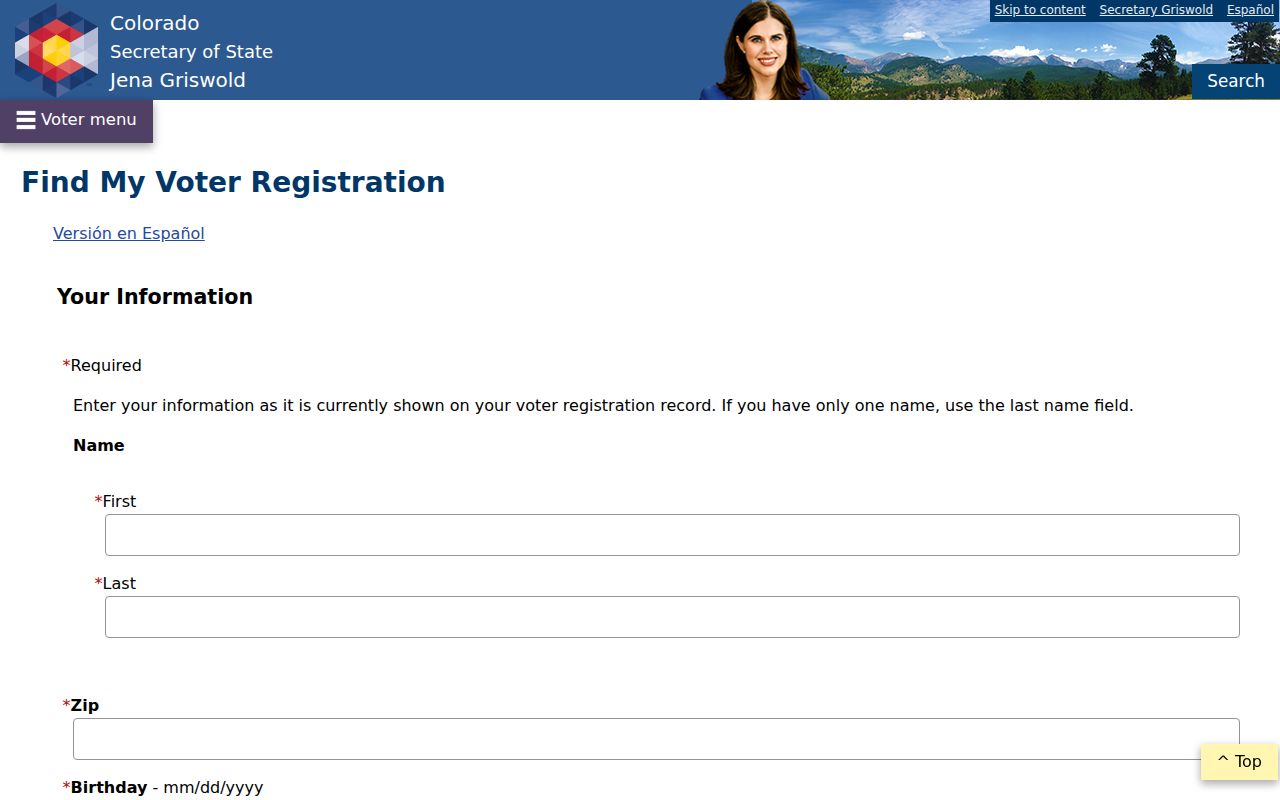
The Colorado voter lookup requires a full birthday and ZIP, and it may hide a confidential voter or a person under 18. County voter products expose a different set of fields and can omit future confidential records. A focused El Paso County resident lookup keeps those limits in view when one person needs to be checked across more than one source.
The state voter lookup illustrates a confirmation route rather than a downloadable El Paso County resident list.
Colorado Voter Records Have a Narrow El Paso County Role
El Paso Elections maintains voter-list, label, and map products, while the state form offers a self-service check. The county page reported 508,811 active registered voters as of June 22, 2026, with unaffiliated voters the largest listed group. That dated total is useful civic context, not a live person search and not proof that any one address has a current household.
Normal voter data may include a full name, residential address, party affiliation, affiliation date, phone if supplied, gender identity if supplied, birth year, and vote history. The county identifies Social Security numbers, driver-license numbers, full birth dates, email, ballot-return envelopes, and signatures as private. Confidential voters can ask the Clerk and Recorder to remove future records from products. Colorado’s Address Confidentiality Program can provide an eligible survivor with a substitute address and mail forwarding.
Use the voter roll as a dated status clue. A confidential, inactive, cancelled, or missing result needs the official Elections office explanation. Do not try to reconstruct a protected address from another public source.
El Paso County Court and Status Records Stay Separate
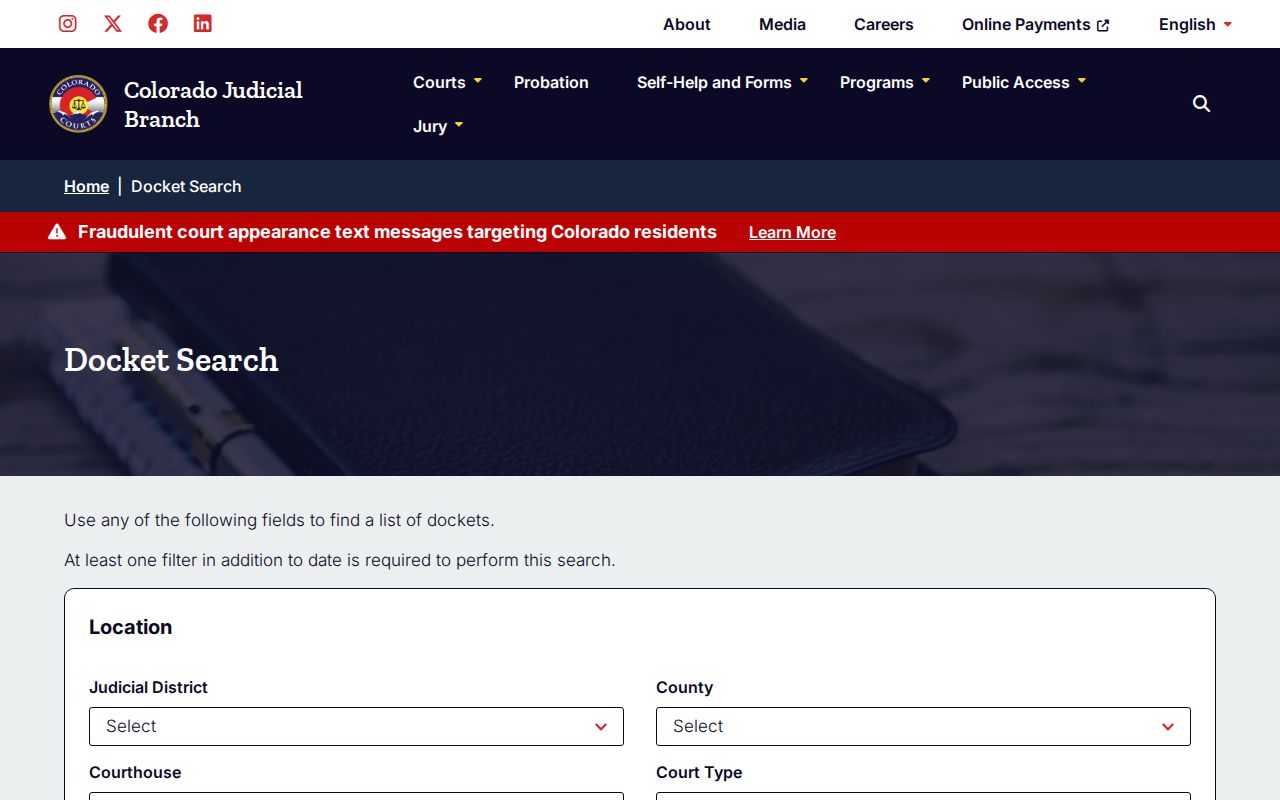
The Colorado Judicial Branch docket portal is built for case research, not for a county resident index. It filters by judicial district, county, courthouse, court type, division, date, case year and class, party name, or attorney name and bar number. At least one filter and a date are required. A docket hit is a displayed matter, not a full case file, residence proof, liability finding, or final outcome.
For documents, use the official record and document request form or contact El Paso Combined Courts at 270 S Tejon Street. The form can request family, criminal, civil, probate, or other document types and warns that sealed, suppressed, juvenile, and confidential records may require identification or remain restricted. A jail result, DOC result, or CBI registry entry has its own status purpose and disclaimer. It belongs in a carefully labeled lookup, never as a shortcut to a resident claim.
The Colorado Judicial Branch docket search shows the location, date, party, and attorney filters that shape a case query.
Birth, Death, and Marriage Records Need Eligibility
Vital records are not an open extension of the El Paso County residents directory. Colorado Revised Statutes section 25-2-117 makes vital records confidential and limits certified copies to an applicant with a direct and tangible interest. The county Public Health route handles eligible birth and death requests, while the Clerk and Recorder handles marriage and civil-union licenses. Divorce and separation records go to the district court.
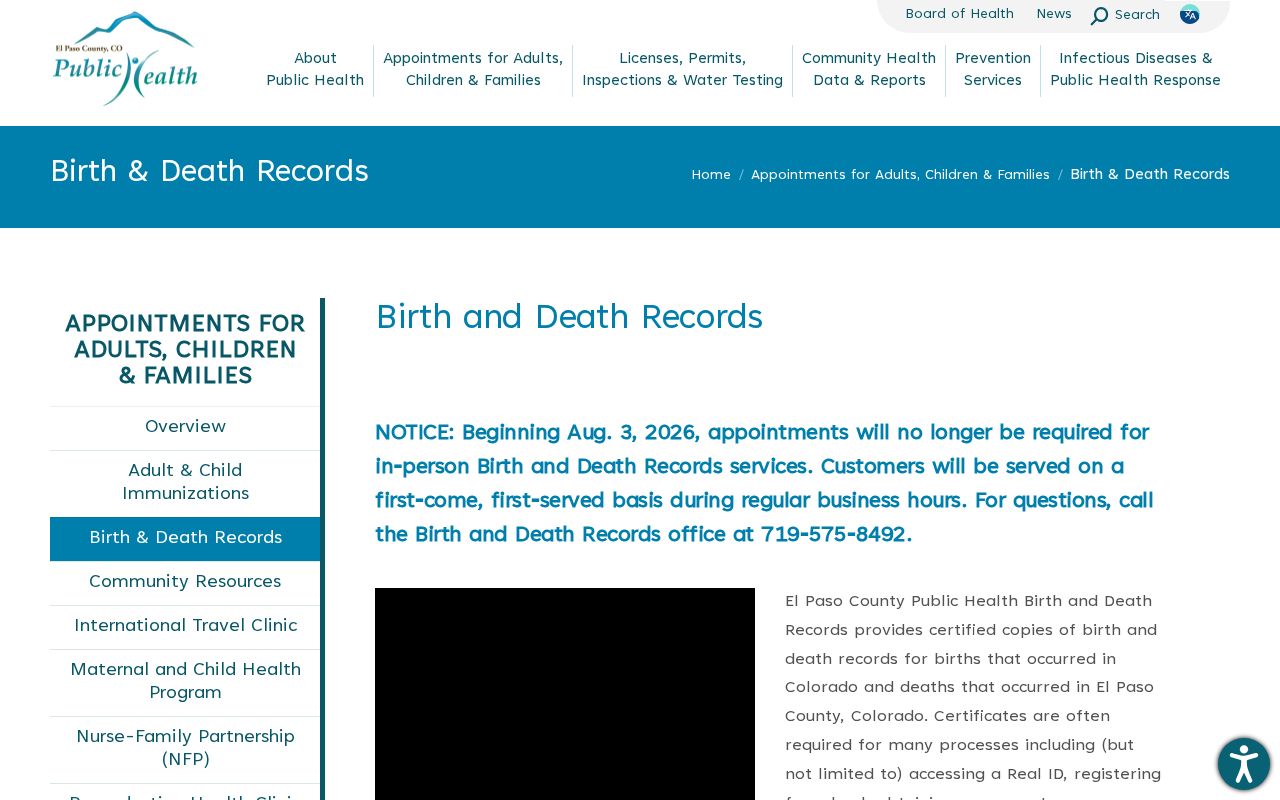
El Paso Public Health lists the Citizens Service Center at 1675 W Garden of the Gods Road, Suite 2044, with a first-copy fee of $25 and additional same-order copies at $20. Beginning August 3, 2026, appointments are no longer required, and walk-ins are first come during regular counter hours. State online ordering is available through GoCertificates or VitalChek, with normal processing stated as 30 business days from receipt. Those details apply to eligible requests and can change, so the official page controls.
The El Paso County Public Health birth and death page shows the local request route and eligibility frame.
The El Paso County marriage index uses party, license, return, date, status, and type fields.
Historical El Paso County Resident Directories
The historical side of the El Paso County residents directory lives mainly at Pikes Peak Library District Regional History and Genealogy. Colorado Springs city directories run from 1879 to the present in the collection, although not every year is available. Coverage reaches Colorado Springs, Colorado City, and Manitou. A directory may list a surname, address, occupation, spouse, business, or community notice, but it records a publication-time listing rather than continuous occupancy or legal ownership.
The city-directory shelf works best when paired with a map or deed. The address cross-reference becomes more useful after 1900. Street names and numbers changed in Old Colorado City and the Westside, especially from the 1870s through 1917, and odd or even numbering sometimes flipped. The full collection and reading method belong on the El Paso County city directory page, while the home route only needs the right historical handoff.
The Pikes Peak Library District Regional History and Genealogy collection is the local shelf behind the historical part of the directory.

El Paso County ZIP Geography Is Not a City Boundary
ZIP research helps narrow a search, but a ZIP code is a postal routing construct. Census ZIP Code Tabulation Areas approximate ZIP geography for statistics and may omit a currently valid ZIP. The working El Paso County service list includes urban 809 ZIPs and county-edge codes such as 80106, 80132, 80808, 80831, 80833, 80840, and 80864. It is a research list, not a certified exhaustive USPS list.
Use USPS for a mailing address, Census TIGERweb for ZCTA geography, the voter form for an individual status check, and an Assessor address or parcel search for property work. A ZIP can cross a municipality or county line. A ZCTA can cover a broader statistical shape. Neither one proves that a person lives at a particular point. The ZIP Code Directory page carries the full list, map distinction, and search steps.
El Paso County Archives Add the Long View
When a current database stops short, local repositories can supply a different kind of resident evidence. PPLD points to NewsFinder citations and full text from 1872 onward, Colorado Springs death registers from 1872 to 1920, church records from about 1873 to 1942, and Veterans Graves Registration from 1870 to 1950. Colorado Springs Pioneers Museum and the Starsmore Center add manuscripts, photographs, ephemera, maps, blueprints, and finding aids.
State Archives series are specific, not one universal opening rule. El Paso marriage holdings include nineteenth-century applications, licenses, and certificates through 1932. Probate spans 1922 to 1976, and divorce series have separate county and district ranges. State Archives guidance says it holds birth records at least 100 years old. Ask for the series, date, and record type. A librarian or archivist can often identify a citation before a requester seeks a restricted certificate.
El Paso County CORA Is the Fallback Channel
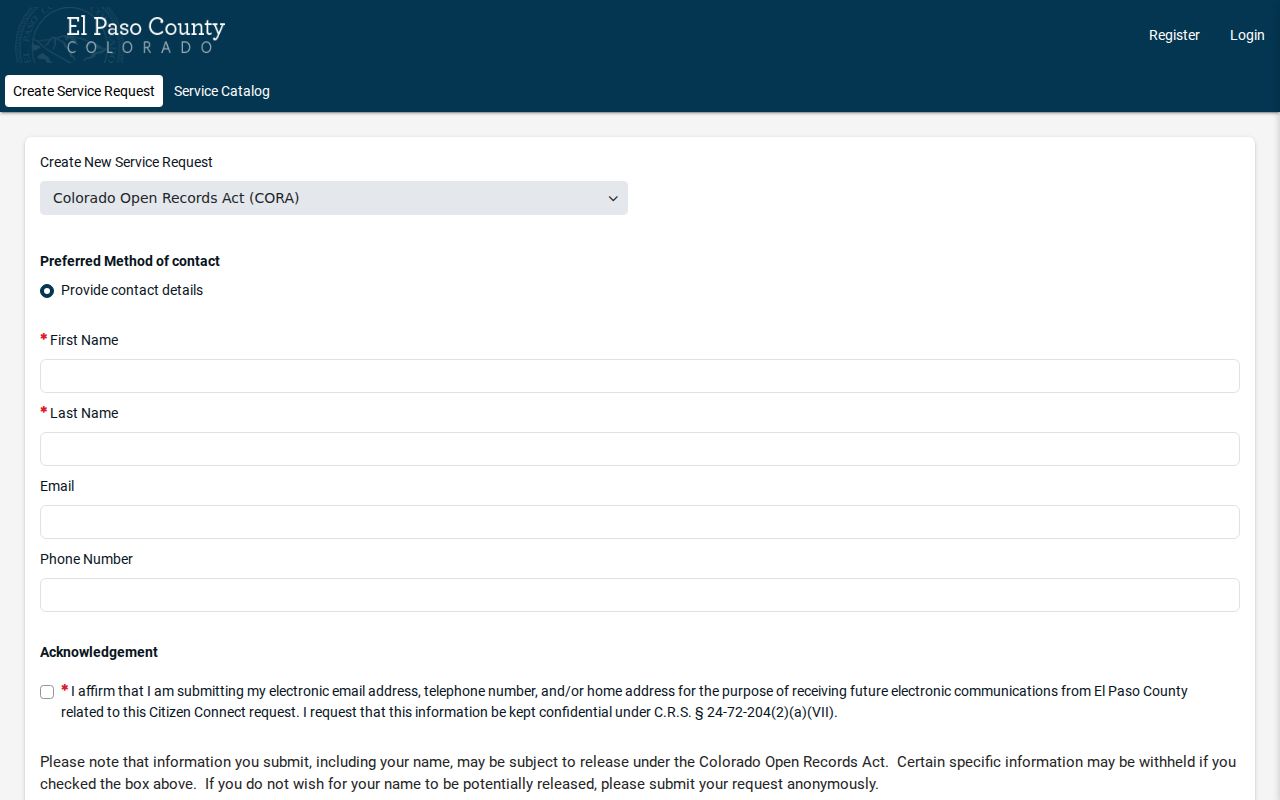
The Colorado Open Records Act, C.R.S. sections 24-72-201 to 206, does not create one central county database. Send a focused request to the custodian that holds the system. El Paso County’s Citizen Connect route requires registration or sign-in to create or review a service request. The county says a response is due within three working days, with up to seven more working days after notice. The first two staff hours are free, then the stated rate is $29.50 per hour, with actual copy, electronic, or other costs possible.
Ask for a record type, date range, parcel, application number, instrument, or system. A request for “all records about a person” is broad and may reach exemptions, redactions, or criminal-justice limits. Colorado Springs has its own CORA route and fee schedule for city-held records. Ordinary access is better when a document already sits online. CORA is the deliberate fallback when a named custodian holds a specific record that the portal does not expose.
The El Paso County Citizen Connect records request entry is the county’s online CORA starting point.
A 1907 El Paso County Directory Snapshot
The 1907 R.L. Polk volume offers a useful numbers story for the historical El Paso County residents directory. It covers Colorado Springs, Colorado City, and Manitou and reports 19,372 names. That count is a snapshot of the book’s coverage, not a census and not a count of every person in the county. The value is in the texture: householder pages, street and avenue guides, business listings, public offices, and names that can be tested against a map or newspaper.
Place a directory year beside the address, then test the same street in a year before and after. Search the surname section, the street section, and historical street names. If a listing changes, the change can lead to a move, a new number, a business shift, or a gap in the collection. The strongest result is a dated community clue backed by a second record, not a number pulled free of its page and place.
El Paso County Recording Alerts Are a Newer Tool
The Clerk and Recorder announced a free Recording Notification Service in November 2025. A subscriber can add up to ten names or name variations and receive alerts about later recorded deed or lien-related documents that match. It is a forward-looking monitoring tool, not a historical directory and not a complete fraud search. The public index and the official fee page still control when a document needs to be checked.
The alert service fits a narrow personal record task: watch a name after a deed, estate, or other recorded interest has been identified, then open the underlying instrument through the custodian. Verify the sender before paying for a copy. County research warns about letters that ask roughly $90 for a deed copy available at $0.25 per page. A free county alert and a focused index check are safer first steps.
Lawful personal use. El Paso County records support genealogy, house history, civic review, and personal record questions. Do not use a name or address trail to stalk, harass, intimidate, or harm anyone.
Official Rolls and Commercial Profile Services Differ
Official El Paso County records are narrow by design. The Assessor shows a parcel relationship. The Recorder shows an instrument. Elections shows a defined voter status. A commercial profile service may blend public and licensed data into a broad result, but its coverage, freshness, and source labels can be hard to test. It is not a substitute for the custodian and should not be treated as a single answer to who lives in a home.
| Route | Strength | What still needs checking |
|---|---|---|
| County or state office | Named custodian, defined fields, official access rules | Eligibility, date, redaction, and scope |
| Library or archive | Dated household, map, obituary, or community context | Missing years, changed streets, publication limits |
| Commercial profile category | May offer a quick lead across many data types | Source quality, false matches, opt-out, and lawful use |
A residents directory becomes more reliable when a source is named for what it actually proves. Keep the public index, the paper record, and the historical clue in separate columns. That simple habit is the difference between a useful research trail and a confident but unsupported identity claim.