
El Paso County City Directory Collections
Pikes Peak Library District Regional History and Genealogy is the principal home for the El Paso County city directory shelf. The collection says Colorado Springs directories run from 1879 to the present, although no claim should be made that every year survives or is easy to view. Early material covers Colorado Springs, Colorado City, and Manitou. Other communities may appear in rural or telephone directories rather than the main city volumes.
The collection is useful because each El Paso County publication has a place and a date. A name can be checked in the alphabetical section, while a street or avenue section can connect a householder to an address. A missing year, changed number, or absent surname is a collection limit. It is not proof that a household did not exist.
| Collection | Years or run | Where held | Access |
|---|---|---|---|
| Colorado Springs city directories | 1879 to present, with gaps | PPLD Regional History and Genealogy | Digital items, microfilm, reading room |
| Early R.L. Polk volumes | 1879, 1904, 1907, 1915 and related years | PPLD digital collection and shelves | PDF or item record when available |
| Digitized local-history items | Early directory and map years shown by item | PPLD Digital Collections | Browse by date and type |
| Rural directories | 1937-38, 1947, 1949, 1951, 1955, 1962, 1969, 1972 | PPLD microfilm or book, PPGS finding aid | Library or collection request |
| Telephone books | Most years from 1907 | PPLD microfilm, class 384.6 C7192CM | Reading-room research |
Research hours shown for PPLD are Wednesday through Saturday, 10:00 a.m. to 5:00 p.m. Materials can be pulled by calling (719) 531-6333 extension 7252 or emailing RegionalHistoryGenealogy@ppld.org. Confirm current hours before a visit.
R.L. Polk Gives El Paso County a Local Shape
The early El Paso County city directory volumes were produced by R.L. Polk and Company. The 1904 edition includes a street and avenue guide, government information, city, county, state, and federal material, business and professional listings, and a Directory of Householders arranged by streets and avenues. The 1907 fourth revised annual edition covers Colorado Springs, Colorado City, and Manitou and reports 19,372 names from the El Paso County local network.
That number describes the book’s listed names, not the full population and not a census count. It is still a useful numbers clue because it shows the scale of the publication and the network it attempted to capture. Use the title page, contents, and page number with the name. If a result is cited without its edition, the same spelling can be mistaken for a current record or a different household.
A 1915 item in the PPLD digital browser identifies R.L. Polk Directory Co. as creator or publisher and runs to 325 pages. Publisher, volume, and page details let a second researcher reproduce the trail.
Reading an El Paso County Directory Entry
An El Paso County city directory entry is compact, but it can carry more than a name. The alphabetical section may list a person, occupation, spouse, address, and an owner or renter mark when the edition uses one. A business entry may give a shop or office address. The street section reverses the path by arranging house numbers and names along an avenue or road. Abbreviations and symbols must be read from that volume’s own key.
Use this sample inventory before copying a result:
| Entry element | Research meaning |
|---|---|
| Name and initials | How the volume indexed the person, which may differ from a modern spelling |
| Occupation or business | Community or work context at publication time |
| Spouse or household clue | A relationship printed by that edition, not a complete family record |
| Street and number | Address clue that needs the edition’s street guide and map context |
| Owner, renter, or symbol | A volume-specific mark that must be decoded from its abbreviation key |
- Householder index
- A section that lists household heads or addresses, not every person using a home.
- Criss-cross directory
- A practical name-to-address and address-to-name cross-reference, often built from street pages.
- Abbreviation key
- The volume’s own guide to initials, occupations, relationships, and symbols.
- Publication date
- The point in time represented by the printed listing, not necessarily the date of a move.
These terms keep a city directory entry within its evidence limits. An entry can anchor a family-history lead, but it does not certify a deed or a current address.
Search the PPLD Digital Directory Shelf
PPLD’s digital browser exposes early El Paso County items such as 1879-80, 1882, 1886, 1888, 1890, 1892, 1894, 1896, 1898, and 1900 through 1902. The collection also carries item metadata for later volumes, maps, photos, documents, newspapers, and genealogical records. PPLD’s search tips recommend advanced searches by date and type, which helps keep a city directory result separate from a map or newspaper item.
Some PDF links can fail or move as a collection is rebuilt. Use the digital item page when a direct file is unavailable, and record the title, year, creator, page, and retrieval date. If the online shelf stops at a gap, call the Regional History and Genealogy desk or use microfilm. The reading room is an access channel, not a last resort.
The PPLD digital collection browser lets a researcher distinguish city directory items from other local-history records.
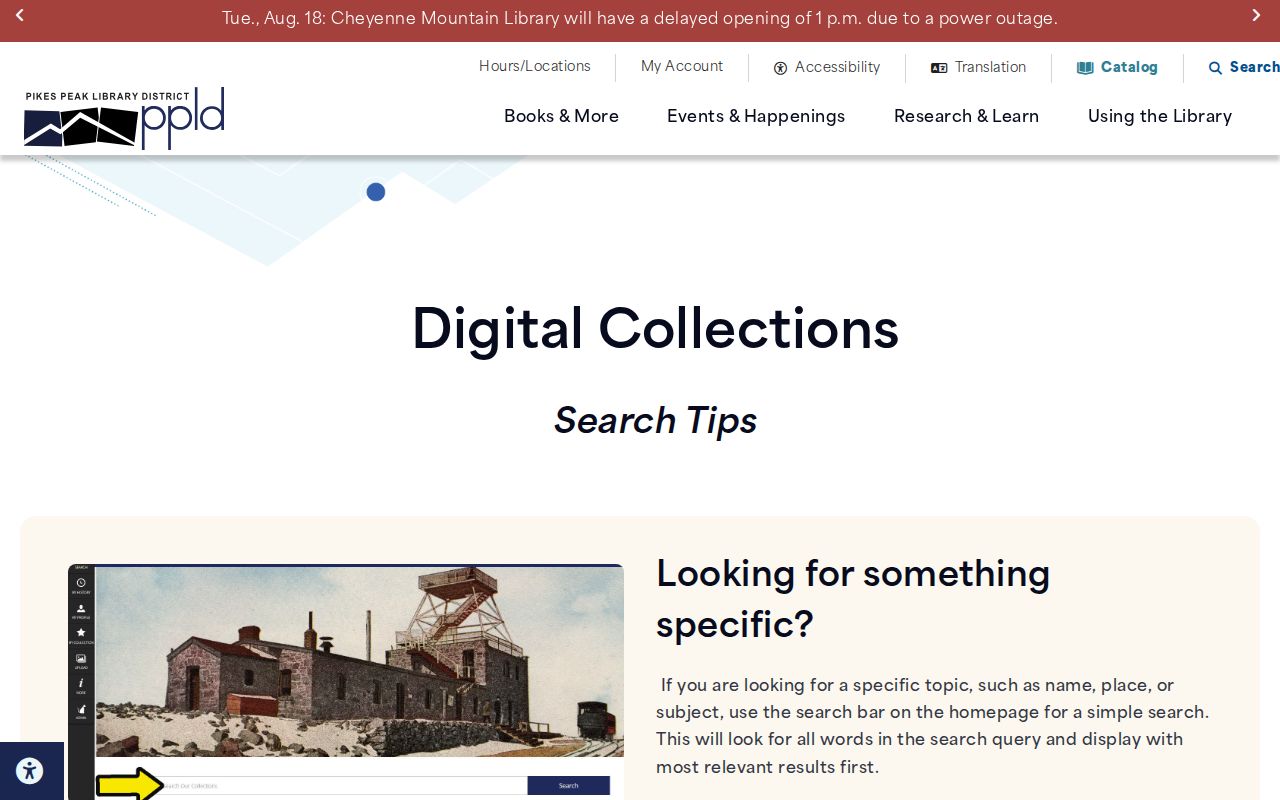
The PPLD digital search tips page is useful when a name search returns a mix of directories, maps, and articles. Keep the item type visible in notes.
Street Cross-References Explain Old Addresses
PPLD says an El Paso County street-address cross-reference becomes more useful after 1900. Search both the surname section and the street or avenue section, then compare the target year with an available volume before and after it. Old Colorado City and Westside street names and numbers changed from the 1870s through 1917, and odd or even numbers sometimes flipped. A modern address string can therefore miss a correct historical entry.
Bridge the two forms with a Sanborn sheet, plat, cross street, lot or block, newspaper notice, permit, or Recorder legal description. PPLD identifies local Sanborn coverage from roughly 1883 through 1960, with a large set around 1907. The map does not name every resident, but it can show whether the lot, block, and building form line up.
A street cross-reference is a method, not a claim that PPLD maintains a separately titled complete reverse-directory series. Preserve the original printed number and the reason for any modern match.
Rural and Telephone Books Extend the Search
City directories do not reach every rural El Paso County address. The Pikes Peak Genealogical Society finding aid points to El Paso County and Teller Rural Directory microfilm for the listed years, plus a 1972 book at PPLD. It also identifies telephone books for most years from 1907 on PPLD microfilm. These sources may catch an eastern address or a small community that a Colorado Springs city volume misses.
Treat a rural or telephone listing as a dated publication clue. Pair it with the Assessor, Recorder, cemetery, school or church notice, newspaper, or archive record that fits the question. A county edge can also change which municipality, library collection, or custodian has the next record. The right directory is often determined by place before it is determined by surname.
The Pikes Peak Genealogical Society resource page is a finding aid to collection locations and years. It does not replace the library volume or certify an entry.
NewsFinder and Archives Add Household Context
A city directory entry gains weight when another dated source explains the move, household, business, or death. PPLD NewsFinder provides Gazette and other-title citations or full text from 1872 to the present, including obituaries. The local databases also identify Colorado Springs death registers from 1872 to 1920, church records from about 1873 to 1942, and Veterans Graves Registration from 1870 to 1950.
Colorado Springs Pioneers Museum and the Starsmore Center hold manuscripts, photographs, ephemera, maps, blueprints, and finding aids. Research access is listed Tuesday through Saturday, 1:00 to 4:00 by appointment, at (719) 385-5650. A newspaper or archive item can support a community connection without requesting a restricted modern certificate.
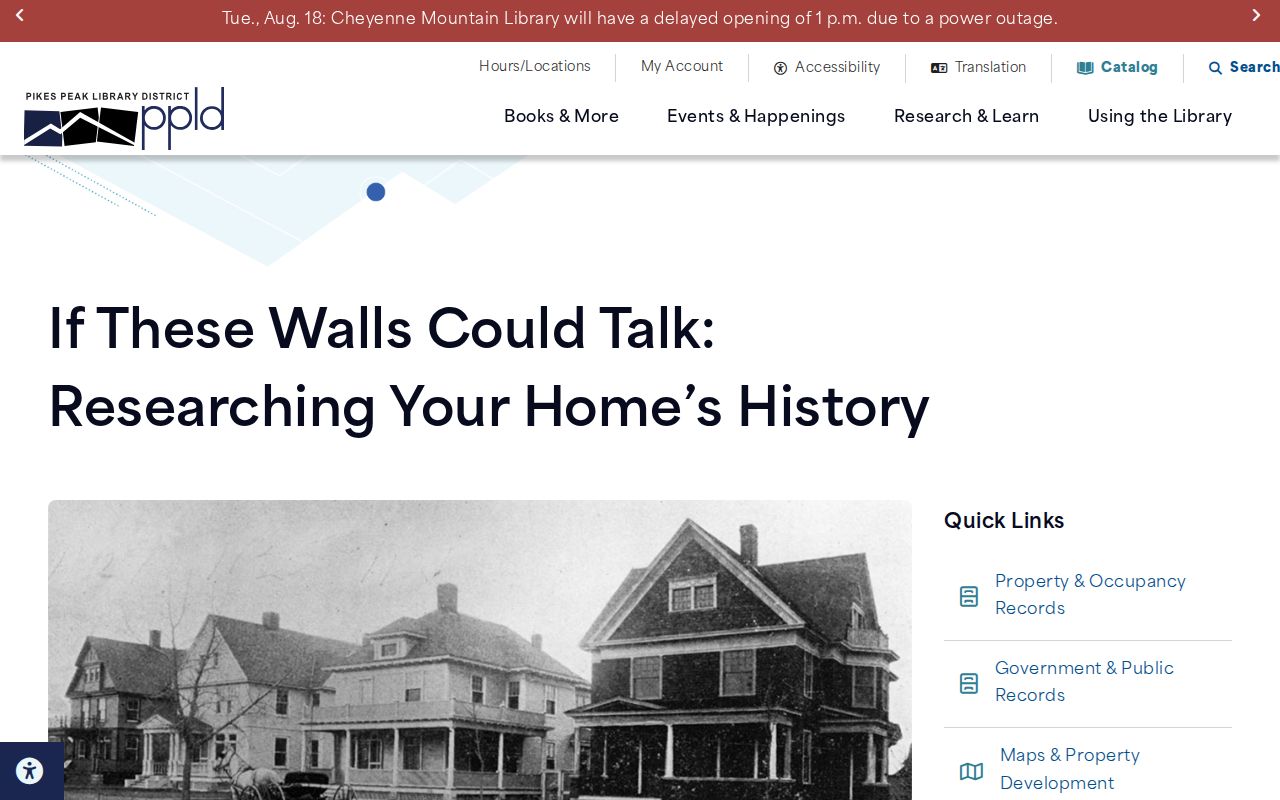
The PPLD house-history guide links directories to permits, Sanborn maps, plats, assessor history, newspapers, and other local sources.
The El Paso County archive route also includes State Archives series for probate, naturalization, marriage, divorce, death, and court material. Ask for a series and date rather than a broad request for a person.
Trace a Household Across El Paso County Years
A family-history search works best as a set of small comparisons. Choose an address and a target year. Find the nearest available city directory before and after that date. Search the surname and street pages, then check a matching census year, newspaper, obituary, cemetery, deed, or permit. The aim is to show how the evidence changes, not to force every year into a single story.
- Write the historic address exactly as printed, including street name, number, and municipality.
- Search the alphabetical and street sections in two adjacent available directory years.
- Check the volume’s abbreviation key and note occupation, spouse, owner or renter mark, and page.
- Compare the address with a plat, Sanborn map, or current parcel record when street numbers changed.
- Use NewsFinder, cemetery, probate, or Recorder material to corroborate a move, death, sale, or family link.
A no-result year belongs in the notes as a collection gap. It is not a negative finding about a household. When a directory find needs a current identity check, move to a narrow official record such as the Assessor or Recorder and keep the historical publication date visible.
What an El Paso County City Directory Can Establish
A city directory can establish that a named person, household head, business, or institution was listed at a printed address in a specific edition. It can reveal an occupation, spouse reference, street pattern, advertisement, or neighborhood clue. It cannot establish legal ownership, a complete household, continuous residence, or a current address. An absent name can reflect an omitted year, a changed spelling, a rural boundary, an indexing choice, or a lost volume.
Keep the title page, publisher, year, page, section, and any map or cross-reference with the citation. Then state the result modestly: “listed in the 1907 directory at publication time.” That wording respects the source and makes the El Paso County city directory useful for genealogy, house history, and local study without turning a historic line into a present-day conclusion.
Research note. A directory is a dated community record. Pair it with a second source before treating a name and address as a continuous household trail.